

Reporting on business and economy news in Canada
Provided by AGP
Automotive Cybersecurity Market 2026 Outlook: Industry Projected to Reach US$ 16.9 Billion by 2034 | IMARC Group
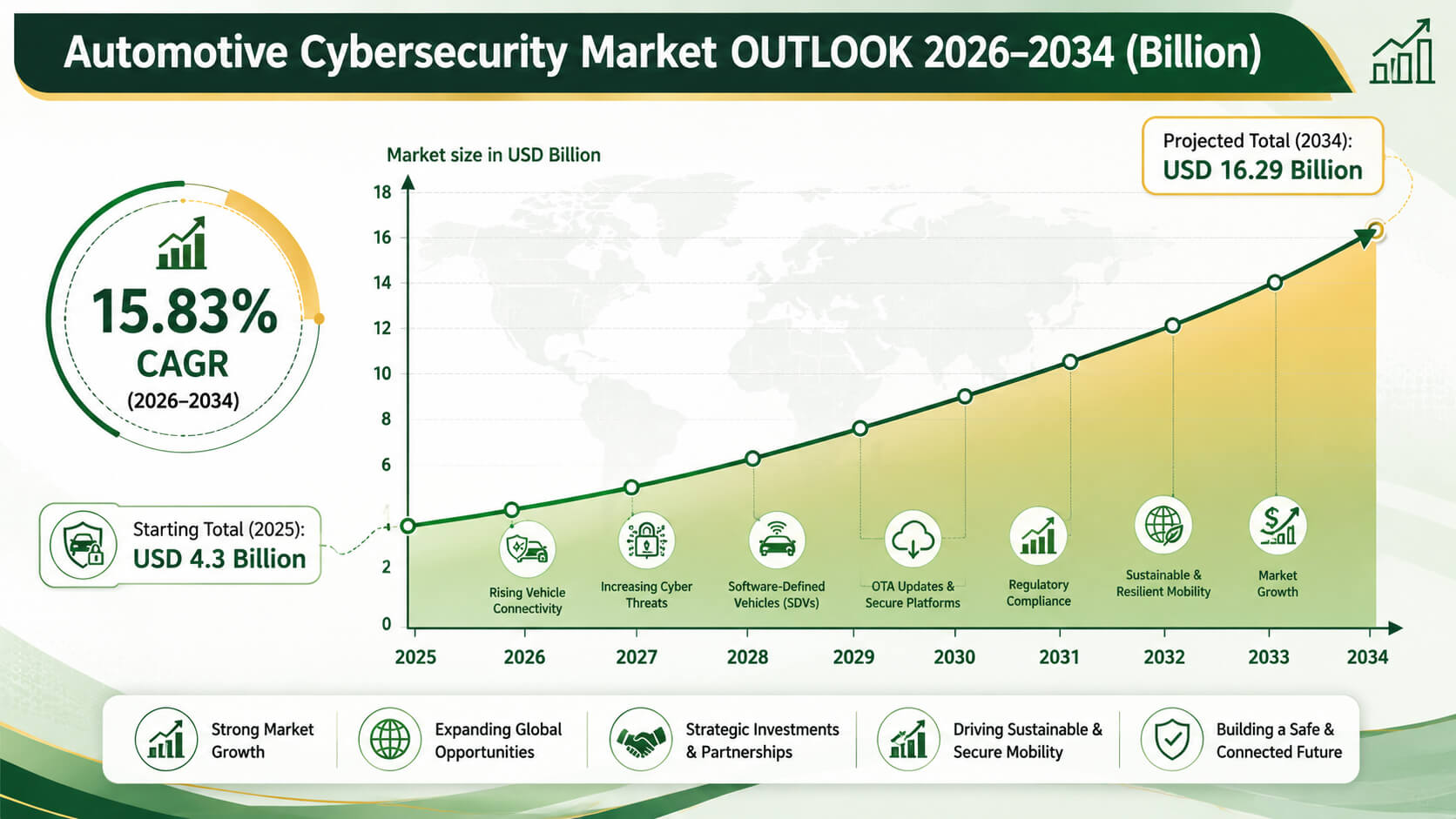
Automotive cybersecurity market outlook 2026-2034
The global automotive cybersecurity market reached USD 4.3 Billion in 2025 to reach USD 16.9 Billion by 2034 at 15.83% CAGR.
NEW YORK, NY, UNITED STATES, May 8, 2026 /EINPresswire.com/ -- The global automotive cybersecurity market reached USD 4.3 Billion in 2025 and is projected to reach USD 16.9 Billion by 2034, expanding at a CAGR of 15.83% during 2026–2034, according to the latest report by IMARC Group. The automotive cybersecurity industry is entering its most critical phase with the UN Regulation No. 155 (UN R155) now mandatory across major markets, software-defined vehicles (SDVs) proliferating, and leading players including Bosch, Continental, Harman, Aptiv, and Upstream Security scaling next-generation intrusion detection and OTA security platforms across passenger cars, commercial vehicles, and electric vehicles worldwide.Automotive Cybersecurity Market - Insights and Key Findings
• Market Size (2025): USD 4.3 Billion
• Forecast (2034): USD 16.9 Billion
• CAGR (2026–2034): 15.83%
• Leading Region: North America
• Top Security Type: Application Security
• Top Form: In-Vehicle (largest segment)
• Top Vehicle Type: Passenger Cars (leading)
• Top Application: ADAS and Safety (fastest-growing)
• Top Deployment: Cloud-Based Security Services (rapidly expanding)
Download a Free Sample of the Automotive Cybersecurity Market Report: https://www.imarcgroup.com/automotive-cybersecurity-market/requestsample
Automotive Cybersecurity Market Outlook 2026–2034
Automotive cybersecurity encompasses the technologies, processes, and standards designed to protect connected vehicles, software-defined platforms, and vehicle communication networks from cyber threats. As modern vehicles integrate up to 150 ECUs, terabytes of software code, and constant V2X connectivity, the attack surface has expanded exponentially making robust cybersecurity a mission-critical imperative for OEMs, tier-1 suppliers, and regulators alike.
In 2025, the global automotive cybersecurity market reached USD 4.3 Billion. By 2034, IMARC Group expects it to reach USD 16.9 Billion at a 15.83% CAGR reflecting the accelerating convergence of vehicle electrification, autonomous driving, and cloud-connected automotive architectures that demand enterprise-grade security solutions embedded from chip to cloud.
What's Happening in the Automotive Cybersecurity Industry Right Now (2026)
UN R155 and ISO/SAE 21434 Mandates Reshape OEM Security Architecture
The most consequential regulatory shift reshaping automotive cybersecurity in 2026 is the full enforcement of UN Regulation No. 155 across the European Union, Japan, South Korea, and expanding markets. UN R155 mandates that all new vehicle type approvals include a certified Cyber Security Management System (CSMS), requiring OEMs to demonstrate end-to-end cybersecurity governance across vehicle design, production, post-production, and decommissioning. Combined with ISO/SAE 21434 compliance requirements, automotive manufacturers are now embedding security-by-design into every phase of vehicle development fundamentally transforming how cybersecurity budgets, teams, and technologies are deployed globally.
Software-Defined Vehicles (SDVs) Create Massive New Cybersecurity Demand
The industry-wide transition to software-defined vehicles where a vehicle's core functionality is governed by software running on centralized compute platforms rather than distributed hardware ECUs has created an entirely new cybersecurity threat landscape. Leading SDV platforms from Volkswagen Group, GM, Stellantis, and Toyota now require continuous over-the-air (OTA) software updates, remote diagnostics, and cloud backend connectivity. Every OTA update pathway, API endpoint, and cloud integration represents a potential attack vector driving demand for automotive-grade security operations centers (SOCs), intrusion detection systems (IDS), and cryptographic update verification systems.
EV and ADAS Proliferation Expands the Automotive Cybersecurity Perimeter
Battery electric vehicles and advanced driver assistance systems are accelerating the cybersecurity challenge. EVs introduce unique attack surfaces: charging infrastructure communication protocols (ISO 15118, OCPP), battery management system (BMS) interfaces, and bidirectional V2G communication channels. Meanwhile, ADAS-equipped vehicles relying on lidar, radar, camera fusion, and AI inference engines require protection against adversarial sensor attacks, GPS spoofing, and control system manipulation. In 2026, every major OEM is deploying dedicated ADAS cybersecurity frameworks as Level 2+ automation becomes the new vehicle standard.
Vehicle SOCs and Real-Time Threat Intelligence Platforms Scale Globally
Upstream Security, Argus (a Continental company), Harman, and others are deploying Vehicle Security Operations Centers (vSOCs) that monitor fleet-wide telemetry data in real time detecting anomalies, correlating attack patterns, and enabling automated incident response across millions of connected vehicles simultaneously. In 2026, vSOC-as-a-service is transitioning from premium OEM offering to mainstream automotive security infrastructure, with subscription-based models making real-time threat intelligence accessible even to smaller fleet operators and tier-2 vehicle manufacturers.
Chipset-Level Security Becomes the New Automotive Hardware Standard
Leading semiconductor suppliers NXP, Infineon, STMicroelectronics, and Renesas are embedding hardware security modules (HSMs), secure boot, and cryptographic acceleration directly into automotive-grade MCUs and SoCs. In 2026, hardware-rooted trust is becoming the baseline architecture for every new vehicle platform, with ISO 21434-compliant HSMs required for ECU authentication, key management, and secure OTA. The shift from software-only to hardware-enforced security represents a fundamental maturation of the automotive cybersecurity stack.
Speak with an IMARC Analyst on the Automotive Cybersecurity Market: https://www.imarcgroup.com/request?type=report&id=7049&flag=C
Automotive Cybersecurity Market Drivers 2026
1. Surging Connected and Software-Defined Vehicle Adoption
Connected vehicles those equipped with telematics, V2X communication, remote diagnostics, and OTA update capabilities now represent the majority of new vehicle shipments globally. Passenger cars, commercial fleets, and EVs all depend on continuous software connectivity, multiplying cybersecurity requirements at every layer of the vehicle architecture. The more connected the vehicle, the more critical and commercially valuable automotive cybersecurity becomes.
2. Regulatory Mandates and Compliance Frameworks
UN R155, UN R156 (OTA software updates), ISO/SAE 21434, NIST automotive cybersecurity guidelines, and China's GB/T standards are driving mandatory cybersecurity investment across every major automotive market. Compliance is no longer optional non-compliant vehicles cannot receive type approval in the EU or Japan, making cybersecurity a hard gating requirement for global vehicle sales.
3. Escalating Automotive Cyber Threat Activity
Documented automotive cyber incidents have escalated sharply from remote keyless entry (RKE) relay attacks and OBD port exploits to sophisticated supply chain compromises targeting tier-1 and tier-2 supplier networks. High-profile incidents at major OEMs have demonstrated the operational, financial, and reputational consequences of automotive cybersecurity failures, accelerating boardroom prioritization and cybersecurity budget allocation across the industry.
4. EV Charging Infrastructure and V2G Security Requirements
The global buildout of EV charging infrastructure introduces new attack surfaces: ISO 15118 Plug & Charge communication, OCPP-connected charge point management systems, and bidirectional V2G energy transfer protocols. Securing EV charging ecosystems from the vehicle's onboard charging controller to the cloud-based energy management platform has become a distinct and rapidly growing subsegment of the automotive cybersecurity market, particularly as V2G grid services scale in Europe, Japan, and North America.
Automotive Cybersecurity Market Segmentation
By Security Type
• Application Security leading segment, protecting in-vehicle apps, APIs, and software stacks
• Wireless Network Security fastest-growing, covering V2X, cellular, Wi-Fi, and Bluetooth interfaces
• Endpoint Security ECU and gateway protection
By Form
• In-Vehicle dominant segment; embedded security within the vehicle architecture
• External Cloud Services rapidly scaling with vSOC and connected backend platforms
By Vehicle Type
• Passenger Car largest segment by volume
• Commercial Vehicle fleet cybersecurity driving accelerated adoption
• Electric Vehicle (EV) fastest-growing segment due to charging and V2G security requirements
By Application
• ADAS and Safety fastest-growing; sensor fusion, perception, and autonomous control security
• Body Control and Comfort keyless entry, remote access, smart access systems
• Infotainment connected media, app stores, and browser-based attack surfaces
• Telematics fleet tracking, remote diagnostics, and insurance telematics
• Powertrain Systems engine control, EV battery management, and drivetrain ECU protection
Buy the Full Automotive Cybersecurity Market Report: https://www.imarcgroup.com/checkout?id=7049&method=3451
Regional Insights: Automotive Cybersecurity Market
North America Market Leader
North America leads the global automotive cybersecurity market, anchored by the United States' large connected vehicle parc, NHTSA cybersecurity guidance, and aggressive adoption of SDV architectures by GM, Ford, Rivian, Tesla, and Stellantis. The US market benefits from a mature cybersecurity vendor ecosystem and deep integration between automotive OEMs and defense-grade cybersecurity suppliers. Canada and Mexico are also scaling automotive cybersecurity capabilities as USMCA-aligned supply chains modernize.
Europe Regulatory-Led Acceleration
Europe is the most compliance-driven automotive cybersecurity market globally. UN R155 enforcement by UNECE member states combined with the EU Cyber Resilience Act and stringent GDPR requirements for vehicle data is driving mandatory cybersecurity investment across every OEM and tier-1 supplier with EU market access. German, French, and Italian OEMs including Volkswagen Group, BMW, Mercedes-Benz, Stellantis, and Renault are deploying comprehensive cybersecurity programs across their entire vehicle lineups.
Asia Pacific Fastest-Growing Market
Asia Pacific is the fastest-growing automotive cybersecurity region, driven by China's massive connected vehicle market, Japan's UN R155 adoption, South Korea's Hyundai/Kia SDV programs, and India's rapidly expanding EV ecosystem. China's GB/T automotive cybersecurity standards and government mandates for intelligent connected vehicle (ICV) security are creating a large, distinct cybersecurity compliance market that is beginning to align with global ISO/SAE 21434 frameworks.
Key Companies in the Automotive Cybersecurity Market
Major players competing in the global automotive cybersecurity market include:
• Robert Bosch GmbH
• Continental AG (Argus Cyber Security)
• Harman International (Samsung Electronics)
• Aptiv PLC
• Upstream Security Ltd.
• NXP Semiconductors N.V.
• Infineon Technologies AG
• Karamba Security
• GuardKnox Cyber Technologies
• Lear Corporation
• Denso Corporation
• C2A Security
Key Takeaways
• Automotive cybersecurity market projected to grow from USD 4.3B (2025) to USD 16.9B by 2034 at 15.83% CAGR.
• UN R155 and ISO/SAE 21434 mandates are the primary compliance drivers reshaping OEM cybersecurity investment globally.
• Software-defined vehicles (SDVs) are creating the largest new demand wave for automotive cybersecurity platforms.
• North America leads the market; Asia Pacific is the fastest-growing region.
• Application Security is the dominant segment; Wireless Network Security is the fastest-growing.
• Electric vehicles and ADAS systems are the highest-growth application areas within automotive cybersecurity.
• Vehicle SOC (vSOC) platforms and real-time threat intelligence are transitioning from premium to mainstream automotive security infrastructure.
• Hardware-rooted trust (HSMs, secure boot) is becoming the baseline architecture for all new vehicle ECU platforms.
Frequently Asked Questions (FAQs) About the Automotive Cybersecurity Market
1. What is driving the growth of the Automotive Cybersecurity Market?
The automotive cybersecurity market is growing due to increasing adoption of connected vehicles, rising cyber threats, and growing demand for advanced safety and infotainment systems.
2. Which region dominates the Automotive Cybersecurity Market?
North America currently dominates the automotive cybersecurity market because of strong automotive infrastructure, advanced regulations, and high adoption of connected vehicle technologies.
3. Why is cybersecurity important in connected vehicles?
Automotive cybersecurity helps protect vehicles from hacking, data breaches, unauthorized access, and cyberattacks that can compromise passenger safety and vehicle performance.
4. Which vehicle segment leads the Automotive Cybersecurity Market?
Passenger cars hold the largest share in the automotive cybersecurity market due to increasing integration of infotainment systems, autonomous features, and connected technologies.
5. What are the major trends in the Automotive Cybersecurity Market?
Key trends include AI-driven threat detection, secure over-the-air (OTA) updates, cloud-based cybersecurity solutions, and increasing adoption of V2V and V2I communication systems.
About IMARC Group
IMARC Group is a leading market research company that offers management strategy and market research worldwide. The company partners with clients across all sectors and regions to identify their highest-value opportunities, address their most critical challenges, and transform their businesses. IMARC's information products cover major market, scientific, economic, and technological developments for business leaders in pharmaceutical, industrial, energy, mobility, and high-technology organizations.
Joy Smith
IMARC Group
+1 631-791-1145
email us here
Legal Disclaimer:
EIN Presswire provides this news content "as is" without warranty of any kind. We do not accept any responsibility or liability for the accuracy, content, images, videos, licenses, completeness, legality, or reliability of the information contained in this article. If you have any complaints or copyright issues related to this article, kindly contact the author above.
